- Based on claims, not surveys
- Physicians, allied health professionals and nurses
- Inpatient and outpatient organization profiles
Provider sTrategy · 3.1M Providers
Your most important provider questions,
answered.
A credential tells you a provider exists. Trilliant tells you how they practice, who they influence and what role they play in your market.
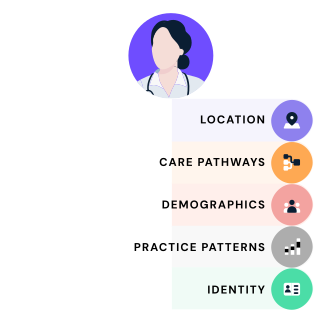
Provider sTrategy · 3.1M Providers
Your most important provider questions,
answered.
A credential tells you a provider exists. Trilliant tells you how they practice, who they influence and what role they play in your market.
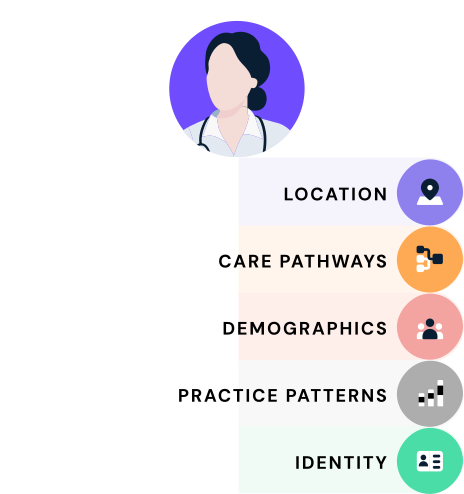

The data
The most expensive thing in healthcare is the physician’s pen.
At its core, the $5.3T health economy is an aggregation of billions of distinct encounters between physicians and patients. Effective physician-focused strategies require a detailed understanding of which physician rendered what services to a patient, how many times, where the physician delivered care and where that patient went next.
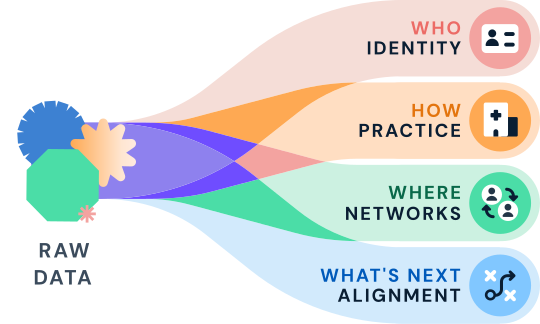
What your network looks like today...

Who • Identity
Physicians and allied health professionals

How • Practice
Practice patterns and patient panels
- Multiple practice locations
- Patient panel attributes
- Payer mix

to whom • referrals
System affiliations and referral sources
- Top referral sources
- Downstream destinations
- Network affiliations
... and tomorrow

What’S NEXT
Improve alignment across providers
- Shifts over time in network alignment
- Prioritized lists of employed and independent providers
3.1M+
Clinician profiles
3.5M+
Healthcare organizations
40+
Attributes per provider record
30days
Monthly refreshes
The Real Problem
How We Map the Provider Landscape
We track practice patterns from claims — updated every 30 days — so you see where patients are going now, not a directory entry that's a year out of date.
Identity | Who EXISTS?
Every clinician in your market, verified.
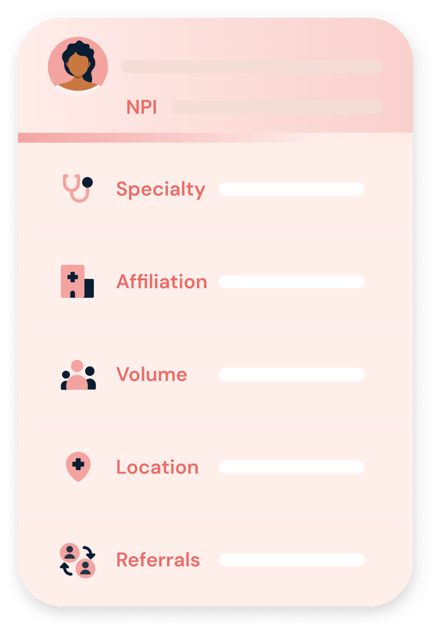
We begin with a complete, verified picture of every clinician — specialty, affiliation, volume and location — so you have an accurate understanding of all the providers operating in your local market.
WHAT YOU GET
- 3.1M+ physicians, allied health professionals and nurses
- Specialty, affiliation and care-setting detail
- Volume and patient panels from actual claims
- 40+ attributes per record, updated every 30 days
Understand | Who MATTERS?
The providers that matter — for your specific question.
Traditional directories return everyone with a matching specialty code. We surface the physicians whose practice patterns — what they treat, how they refer, which settings they use — actually match the question you're trying to answer.
WHAT YOU GET
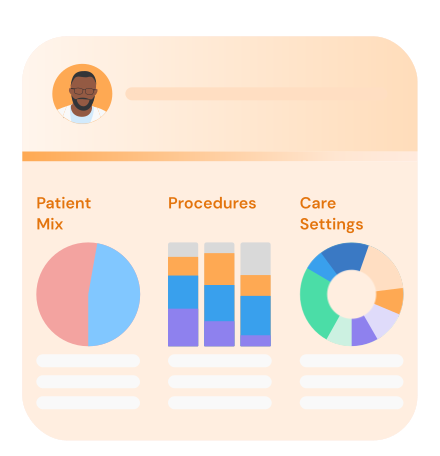
- Procedures and conditions actually treated
- Patient panel demographics and payer mix
- Practice patterns from claims — not self-reported
Connect | Who refers to whom?
Map the referral network — sources and destinations.
Referral relationships shape where patients go next, but they rarely show up in a directory or a single claim. We surface referral patterns — who refers to whom, and how often — from billions of visits, not surveys or self-reported affiliations.
WHAT YOU GET
- Top referral sources and downstream destinations
- Network affiliations and practice locations

Prioritize | What should we prioritize?
Not every provider represents the same opportunity.
Not every provider represents the same opportunity. We rank physicians by their effect on your organization — using referral volume, patient panel size and downstream revenue, not intuition.
WHAT YOU GET
- Prioritized physician recruitment lists
- Data-driven physician needs assessments
- Leakage reduction targets by referral path

Go deeper: try it yourself
An Open-Access Provider Directory
The Provider Directory is a free database where you can explore the data yourself — no demo required.

01
Search Physicians
Find any provider by name, specialty, or location.
02
Research Their Practice
See where they practice, what they treat and who their patients are.
03
Prioritize Your Outreach
Know which physicians are worth pursuing before you make the call.
RESEARCH
Free research.
No consultants required.
Trends Report • 2025
Ambulatory volumes dropped 3% YoY across independent urgent cares, but grew 8% in hospital-owned urgent care

what the data shows
3x
The spread in negotiated rates for a knee replacement within a single metro market.
Same procedure. Same city. The payer determines the price.
+11%
Outpatient cardiology volume over 4 years — while inpatient volumes fell 6%.
Where care is delivered has shifted faster than most strategies acknowledge.
72%
Of cardiologists are now health-system employed — up from 52% five years ago.
Alignment is moving. The networks you see today are not the networks you'll negotiate with tomorrow.