How It Works
Turning disparate data into intelligence you can trust.
One procedure can produce multiple claims across different providers, facilities and labs. Our four-step process reconstructs them into one longitudinal patient journey.
Everyone starts with the same raw claims. The advantage is what you do with them.
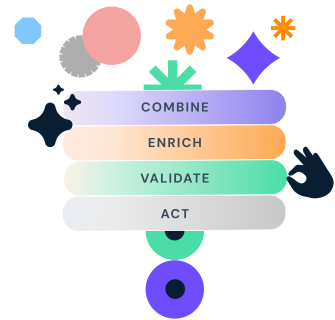
How It Works
Turning disparate data into intelligence you can trust.
One procedure can produce multiple claims across different providers, facilities and labs. Our four-step process reconstructs them into one longitudinal patient journey.
Everyone starts with the same raw claims. The advantage is what you do with them.
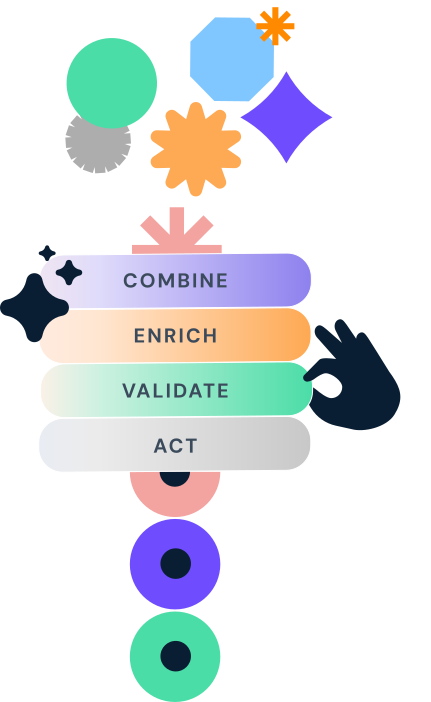
Our Process at a glance
Combine
Raw records
Enrich
Visit-level records
Validate
Validated events
Act
Actionable answers
Multiple claim lines from different providers and systems
- Lab
- Radiology
- Professional
- Facility
- Pharmacy
One complete, validated view of the real-world event
- One patient
- One place
- One episode of care
The Problem With Raw Claims
A claim is a receipt.
Not the full picture.
Providers submit multiple claims for a single procedure, each capturing different pieces of the same event.
We connect them into one encounter: a Visit.
THE TAKEAWAY
Multiple claims. One visit. A usable picture of care.
We reconstruct real visits, giving you a longitudinal view of patient journey.
The Foundation: combine
Multiple sources, one integrated dataset
Why it matters
Single-source datasets miss the full patient journey. Integration across multiple sources is what transforms fragmented billing records into actionable intelligence.
What we collect
Coverage
300M+
3.1M
9B+
10+
* all 50 states plus DC
The engine: Enrich
From claims to Visits
A single procedure scatters across a dozen claims: physician, facility, anesthesia, pathology, with no explicit link between them. Machine learning reassembles them into a Visit: one patient, one place, one episode of care.
We hand-connect thousands of claims into Visits, then train machine learning to scale that judgment to billions. It is the most valuable, and most difficult, thing we do.
The difference
This is the hard part everyone else skips. Structuring raw claims into events is what turns a pile of receipts into analyzable truth.
What machine learning builds
Visits: event-level episodes of care from scattered claims
Referral intelligence from real provider activity, not self-reported affiliations
Demand forecasts across 165,000+ service-line models
The scale it runs on
Billions of claims every year
Tens of thousands of procedure and diagnosis codes
A long tail of edge cases, handled automatically
The difference: Validate
Expert curation & validation
Machine learning only knows what people teach it. Our curation and annotation teams, comprised of clinical and operational experts, build the training data by hand, then validate what the models produce.
They bring the judgment that separates a real clinical signal from a billing artifact. The measuring stick is simple: can you trust the answer?
Why it matters
The models are only as good as the experts behind them. Human judgment is where accuracy is won.
What expert validation removes
Billing artifacts and phantom charges
Duplicate and administrative records
Inconsistent definitions across sources
Out-of-date provider and affiliation data
The output: Act & Decide
Actionable intelligence → decisions you can defend
Data transformed into answers you can immediately use — delivered the way you need them. Self-service tools for individuals and SMBs; enterprise-grade analysis with strategic advisory for health systems.
Always Current — updated continuously, so you are never working from stale information
Why it matters
The difference is not the algorithm. It is what the algorithm runs on — and the people who interpret what it finds.
how it's delivered
Explorer Applications
Custom Reports
Workbench Dashboards
Data Delivery
Strategic Support
Why This Matters
Everyone has access to the same raw claims. The advantage comes from structuring them, validating them, and knowing how to use them.
Most organizations stop at the raw claim. Trilliant does the hard work of turning receipts into event-level Visits, and validating them, before anyone acts on the answer.
Hal Andrews · President & CEO, Trilliant Health
Resources
Read more about our approach
Tech Blog
An inside look at how we tackle technical problems
Product Blog
Inside our products: enabling evidence-based strategy
Field Guide
Our framework for competing in healthcare's negative-sum game
In Healthcare's Negative-Sum Game
What do you need to know to win?
What questions do you wish you could answer?
Frequently Asked Questions
More About Our Process
Answer copy to be written. This paragraph stands in at about the length a real answer runs, so the open accordion can be reviewed for line length, paragraph spacing and the rule that closes each item.
A second paragraph follows, because most of these answers will run to two and the spacing between them is part of what is being reviewed.